


As we began our walk outside of town we thankfully ran into the cook from the school which meant the tractor heading from town to school (once a month only when it comes to town to bring construction supplies) hadn’t yet left. We could hitch a ride with the tractor and save ourselves the walk. Thank goodness for BST – Bhutanese Stretchable Time. It was past noon, and the tractor was supposed to leave at 10:00am, but it hadn’t left yet.
It was quite a scene to get on the tractor, as the tractor was full of supplies, materials for cement, which were quite dusty, and the cart was already filled with several villagers. There appeared to be discussions going on about where we were going to sit, and some of it seemed to be about me, because as often is the case Bhutanese are very reverential towards foreigners, and they seemed to not want me to sit on the dusty cement materials and get myself all dirty. I tried to explain that I was grateful for the opportunity to ride in the tractor instead of walking and that I didn’t mind it at all, and that I also didn’t mind the fact that it was going to be a very bumpy ride, which they were trying to explain to me and make sure that I would be comfortable. They finally brought some empty boxes, dismantled them to prepare seats on top of the bags of cement supplies, for us to sit on, and we were ready to go.

We finally set off and wow was it a bumpy ride. It seemed for us, the bags of cement were providing somewhat of a cushion, while our fellow riders who were sitting on the metal of the cart, were suffering much more. Several times, they literally stood up, balancing themselves, it was better than having the pain of the bumps from the metal. As we climbed higher and higher on the mountain above Trongsa the view of the Trongsa Dzong, the town itself, the valley, and the surrounding mountains was spectacular. The ride was extremely bumpy, with dust from the supplies, mud from the road (flying off the wheel) flying everywhere. Bugs, flies, insects and the sun.
On the driving part of the tractor, the front part, there were five or six men, Indian laborers and Bhutanese riding along, squeezed in surrounding the driver. They were also headed towards the school, where they work on the on-going construction of the school. In the cart behind us and next to us sat the cook from the school, a school boy, two young village men and an old villager from villages not too far from the school (several hours walk it must be). These villagers not only live in a super remote place, they also speak their own dialect, so even my friends cannot really communicate too well with the older ones, as they don’t even speak Dzongkha.
Now, back to our journey. We were jumping up and down, laughter and smiles abound. The villagers were getting a kick out of the fact that a chillip (foreigner) was on board. But, not long after we started our journey, maybe a half an hour in fact, we hit a road block. A truck carrying huge rolled up electricity wires (they are working on connecting a village half way up towards Karshong to the grid) got stuck in the mud, one side of it falling half way into the side of the road, and almost to the gorge below it. A few men were already working on unloading its cargo and now all the men from our tractor joined in the work. There was a Toyota pick up truck with the project contractor there, connecting the truck to its rear with very thick ropes and they were trying to unload these super heavy wires which were rolled up into thick rolls. The truck looked to be thoroughly stuck and the task at hand looked impossible and time consuming. We debated whether we should start walking or wait. Since we still had about three quarters of the walk left we decided to wait a while and see if they succeed.

We passed the village that was being connected to the electricity grid (by village, I mean three or four houses and a Chorten). Sonam Lhamo told me that this is the last village before the school.
But it was not too long after we passed this village and right after Sonam Lhamo finished explaining to me that we were coming up towards the hardest part of the walk where we have to walk straight up to the top of the mountain to our right that we hit a terrible part of the road, our cart bouncing violently left and right several times and suddenly we were stuck, could not move. The right side of our cart was totally tilted down. We looked to the side and the right wheel had completely fallen off. So, there they were, all of the men, hurried out to examine the situation and start working on a fix.

There was a stream running through the road, and our right wheel got stuck right in the middle of a pool and a rock in it. The wheel had come off and the part of the cart that connects to the wheel was stuck inside. They had to work to lift the cart enough, searching for appropriate size rocks so they could fit the jumper exactly to actually generate the necessary lift. They managed to lift the right side enough to find out that actually a very crucial piece that would connect the wheel was missing. Hands dirty from the mud, went into the pool searching for this missing part but to no avail.
We knew that for us this was the end of the road. The men would continue to work on fixing the cart, but it might take hours, and it might require going back by foot to town and getting the necessary part. So, we took our bags and started to make our way up the mountain. We had about an hour and a half of walking left, and unfortunately had to climb the very part of the journey that Sonam has just spoken about.
As we walked up through this steep “short cut”, that went straight through the dense forest, we went through an area, where Sonam pointed to the trees and said, this is where bears live, you can see by the leaves, she said. This area is well known for the bears. Oh jeez, I thought to myself. Here we were two young women teachers, me and a school boy walking up through the jungle, with snakes, bears and other wild animals potentially lurking. I was hoping we would have no wild encounters.
Actually it really wasn’t bad at all and the scenery was wonderful. The sun shinning on the mountain ranges, while sheets of rain in the distance were being lit by the sun. The so called difficult part lasted only thirty minutes and we were quickly back on the dirt road, which would lead us in one hour’s time to the school.
Then, we arrived at the school, literally in the middle of nowhere. But the view, wow! So wonderful. As we arrived in the late afternoon, the beauty of the light and clouds above the multitude of mountain ranges was stunning.

Now, this school, and everything that is happening here is so amazing. Four teachers, a principle, sixty three students, and one cook. A school in the middle of nowhere, truly a settlement in the wilderness, with six or seven small rooms for classes and an office and an adjacent two small houses for the teachers’ quarters perched on top of a steep slope on the side of the mountain. Out houses down the hill, a moderate size dirt patch in front of the school with a tall prayer flag flying high, and several wood benches, for assembly gatherings. Construction everywhere, a bigger dirt patch below for a football field and several small huts in the surrounding areas for the children that stay on site during the week and the Indian laborers.
The school...

 Hangin' out at school...

 Class.

My hosts’ house was very modest, with no electricity, but with a bukhari stove and batteried lamp which they charge during the day from solar. Once the sun sets in this little hamlet, it’s dark!

Ranges of mountains surrounding us in a 360 degree panorama. Landlocked fully, nowhere to go, except more mountain ranges in each direction which take days to cross by foot, and no roads, or vehicles around. This is the “real” Bhutan that everyone speaks of. The Bhutan that is outside of Thimphu still exists. Small villages scattered scattered all throughout this harsh and demanding terrain. Still no roads or electricity. This is what Bhutan used to be like all over the place, though it is shrinking as areas are being connected by electricity and roads. Surely, it is a good thing that peoples’ hardships are alleviated, but with such advances comes a loss to. Electricity and exposure to mass culture through the media, changes the nature of these people. The simple life is changed, one’s relationship with nature and the environment and so do the sense of meaning and purpose and perspective in one’s life.


On the way to the Lhakang we sopped at the “shopping complex” which is the running joke here with the Sonam’s. Saying that down the road is the shopping complex and just a little bit further down lie the movie theaters. Funny stuff considering how remote and underdeveloped the area really is. Anyway, the “shopping complex” was a little house along the way that is also a small shop that sells a few necessities for passerbyes. We took a few sweets (that’s a necessity isn’t it) and the last pack of biscuits (the joke by Sonam Tsoki, was that tomorrow the helicopter will be delivering new batch of biscuits).


Then we made our way towards the Lhakang: Ugyen Thegchok Choling in Karshong, which was founded by the Ninth Gangteng Tulku (Kunzang Rigdzing Pema Namgayl). He also runs Gangteng Gompa and the Yeshe Khorlo centers all around the world.
The young Samling Tulku (a reincarnate lama) stays at the Lhakang and I asked Namgayl, one of the teachers if he might make the request on my behalf that the Tulku bless me and give me my Bhutanese name. Here in Bhutan, almost everyone receives their name from a Lama. When a baby is born, the parents take their child to receive a name from a teacher. In recent times, I have heard that some parents go to more than one lama if they didn’t like the name they received. I think, it is fairly common for foreigners who live here for a while to go to a lama and receive a Bhutanese name. Names here are usually loaded with meaning, most often relating to Buddhism. I had been thinking about getting a name for a few months, and all of a sudden, unexpectedly the perfect opportunity emerged. The young Tulku, perhaps no older than 13 or 14 looked at me briefly, with a kind of curiosity and promptly spoke: Sangye Rigden. And how interesting that I should receive Sangye (spelled Sangye or Sangay) as my first name, when in fact on the bus ride to Trongsa while I was thinking that I still needed to find a lama to give me a name, I thought of how Sangye would be a nice name. And I never imagined that I would receive my name in the middle of nowhere in Trongsa. We asked to take some photos with the Tulku, who was very shy but accommodating and from there we made our way back to the school for the night.

 The view from the Lhakang.

The Tibetan word “Sangye” means, “Buddha”, and the term Rigden can refer to a “cosmic principle of wakefulness that exists as a potential to manifest in human society”. I happen to really like my birth given name, of “Noam Lemish”, but I think “Wakeful Buddha” is not a bad name to have as your backup…
As we walked back towards the school from the Lhakang it was starting to get dark. The sun had set and there was still a good deal of walking left. My eyes were glued to the ground as we walked, trying to make sure there were no snakes on the ground. I didn’t want to step on one. The thought of what we would do if one of us got bitten by a snake was frightening. The closest medical facility was a four hour walk away. So many sticks on the ground, it made me think of the famous Buddhist analogy for our state of delusion in samsara, mistaking a rope for a snake. Well, here I was in the Trongsa jungle, it was getting darker, and I definitely had my eyes glued to the ground, trying not to mistake a snake for a stick. In fact, every time we took a walk around the jungle, it made me think of the intense vulnerability that is the reality of humans living in such wild areas. Bears, snakes, and perhaps even tigers in the area. Nothing much to do if you have an encounter with such an animal.
There is a great sense of camaraderie, a kind of brotherhood and sisterhood between the four teachers that live and work at this school in Karshong. They eat meals together, take their evening and afternoon walks together, and entertain one another. The strength of their community keeps them strong while facing the challenges that their work and living conditions present.
The following day during lunch time a remarkable double rainbow appeared. A full circle rainbow all around the sun, straight up in the sky. I had never ever seen anything like it. And below it a larger rainbow that was not complete.


In the afternoon after the teaching day was completed, the four teachers and I went on a walk in the opposite direction of where we had walked the previous afternoon to the Lhakang. On the way we passed the huts of the cow herders who live in the area. All of these herders are women, and there were lots of kids playing around. Some were school kids that actually reside at the Karshong school and some were the cow herders’ children. Apparently, these women in the spring and summer take their cows away from their village and move along with them from one grazing area to the next, every three of four weeks. In every area there are huts set up for use already there year after year.
 Children in the cow herders' living area...

We stepped in to have some tea at one such extremely modest hut. Basically, just one small room in this hut. Kitchen, bedroom, living room, guest room, everything in one tiny space. These women cow herders and the whole experience in general was really amazing to behold. I have only ever seen such communities in movies. People living in such remote areas, living under such harsh conditions, and yet displaying such a kindness and friendliness, openneness, a sense of community among them, and seemingly a kind of quiet contentment.
It is amazing to think of how remote this school really is, some children have to walk up to an hour a half a day in each direction to go to school. Other children whose homes are too far from the school by foot for daily walking, are accommodated at the school with very modest huts. A small community is thus created amongst these children, the teachers and the Indian laborers that live on site as well. We played football down in the dirt field, in the evening after we returned from our walk. The “stay at school kids”, two male teachers, the Indian laborers and myself playing football in the mud and drizzle, having a great time. Football, the great equalizer, bringing together people from all corners of the world so easily. No words necessary.
One child who stays at the school site is the 8 year old Sherab Wangmo. She stays with the Sonam’s and is shy beyond words. She is actually mostly silent, solemn and seems somewhat unhappy. Perhaps she really misses her mother (there is no father, I understand). It must be so hard at such a young age to stay away from your mother, your home, your village and everything familiar, and to live with strangers, teachers. I tried hard to make her smile and play. And when I engaged her about colors or cards, she did respond, but only temporarily.

He doesn’t speak any English which for me worked well, as I prefer to walk quietly rather than have idle conversation. The only talking we really did was when he would point at villages on the other side of the valley and name them or point at something along the way such as water or mud and say what its called in Dzongkha and ask me what it’s called in English.
The walk was tiring but not exhausting. It was mostly nice. Neither downhill for long stretches nor up hill. We walked along two or three mountain ridges, went mostly moderately down, gradually, following the dirt road that we had moved on by tractor when we came up and took two steep downhill shortcuts through the woods.
Approaching Trongsa town by foot from above...


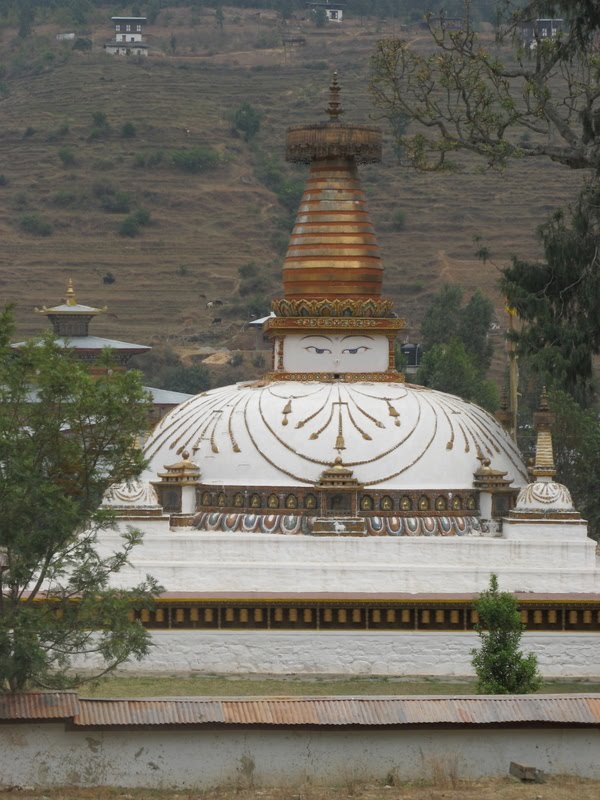
The following day early in the morning I made the short walk from the hotel to the entrance of the town where the bus dropped me off, ready to begin the journey back to Thimphu. For the first hour or so the bus was full but quite normal, we stopped several times along the way and picked up people. It was a very holy day in Bhutan, Buddha’s Prananirvana, and later it would become clear to me where all these villagers were headed. They were headed to a big chorten along the way, maybe an hour and a half drive outside of Trongsa itself.
But, before we reached the chorten itself, the bus was stopped by a group of people, waving the yellow bus tickets. Apparently, many of the passengers on the bus were not actually ticket holders, but just given a lift by the driver. So, he instructed those who don’t have tickets to get off the bus, and he stepped out and started loading up the bus roof (which is where all the luggage is roped and taken along as cargo) with all the stuff that this large group of people had. It was bag after bag after bag. It seemed like we were about to take an entire villages’ worth of belongings to Thimphu. I wasn’t actually sure what was going on. I thought maybe a couple of people were moving from this village to Thimphu. But eventually a group of approximately ten men, mostly young ones in their 20’s came on the bus, they said hearty goodbyes to friends who stood with them and were not joining and off we went after the half hour delay.
Immediately, everything about the bus ride changed. These men were full of energy, loud, jolly and full of a sense of entitlement about the bus ride as if they were the only passengers on the bus. When a group travels like that together, there is a sense of obliviousness about anyone who doesn’t belong to your group.
In talking briefly to a couple of the men, I realized that they were coming back to Thimphu after being away for three months, conducting surveys on the hydrolelectric power. They travel by foot in very remote areas. It’s a harsh life, exhausting, kewa datsi (potato cheese curry) every day which “in the summer turns sour before we even have chance to eat it for lunch” .
Insects and leeches every where, very low pay, far away from family from any kind of city amenities. But much like the teachers in Karshong, they were like brothers to one another with a deep sense of camaraderie, and on this day they were full of joy and excitement as they were coming home after a long time!
The man sitting in front of me, was the leader of the group and he was clearly older and they all called him sir. He was in charge of the songs. The bus drivers in Bhutan have these MP3 players and they rotate songs.
This man in front, cranked up the volume very high, and they all sang so loudly, especially a young man sitting across the way from me, who would almost scream instead of singing, and hold the notes far too long on purpose and sing somewhat out of tune.
Well, eventually we made it back to Thimphu, after a long and bumpy ride, full of delays. I was happy to be back “home” and truly grateful for the opportunity to visit this remote and beautiful part of Trongsa.
~~~~~~
Yours, as always,
Sangye Rigden




 Posts
Posts


